
Home / Materials
Materials & Selection | Choosing stainless by environment & use
First clarify the use environment and the material's role (structural / decorative / functional), then the grade: 304, 316L, 2205, 2507, 445J1, 430–444 tiered by environment.
Selection isn't 'the more expensive the better', nor 'pick a grade first'. Clarify three things: <b>where (environment)</b>, <b>what it does (structural/decorative/functional)</b>, <b>what media it contacts</b> — the grade is just the answer to these. 'When NOT to use' matters more than 'which to use'.
Three questions before selection
| Ask | Why it matters | Example |
|---|---|---|
| Where — service environment | Indoor dry, outdoor weather, coastal salt mist, chemical media, high/low temp — corrosion level sets the grade tier | Indoor appliance panel: 430; long-exposed roof/facade: 443; chlorinated tap-water tank: 444 or 445J1; seawater: 2205 |
| What it does — role in the equipment | Structural: strength & weld safety; decorative: surface & look; functional contacting media: corrosion & hygiene; wear: hardness | Frames/shells: 304 enough; product-contact liners/pipes: 316L or 444 by media |
| How it's processed, how much welded | Heavy welding/bending changes behavior; welds often fail first | Weld + corrosion: prefer 439 (Ti-stabilized); complex/heavy field welding: 316L steadier |
Quick lookup by use
| Your use | Direction | Note |
|---|---|---|
| Structural (frame, bracket, base, shell) | Mostly 304; corrosive or heavy-load: 2205 | Check strength & weld quality, not just 'will it rust' |
| Decorative (elevator, door, appliance, architecture) | Indoor 430 cheapest; long-exposed roof/facade: 443 | Environment sets tier; don't use 430 outdoors |
| Water storage (tank, heater liner, treatment) | 444 first; higher chloride/higher temp: 445J1 | 304 tanks have weld-rust failure cases; residual chlorine is the hidden killer |
| Media-contact functional (pharma, food) | Contact surface 316L (Mo, Ra≤0.8μm, traceable) | 304 only for non-contact structural |
| Seawater & salt mist (coastal, desulfurization) | 2205 / 2507 | 316L can still pit in seawater |
| High-temp (furnace, heat exchange, exhaust) | 310S heat-resistant; auto exhaust 439/436 | Check temperature range & oxidation |
| Wear parts (blades, edges) | 420, heat-treatable to HRC50–55 | Need hardness → martensitic, trade off corrosion |
Ferritic corrosion gradient
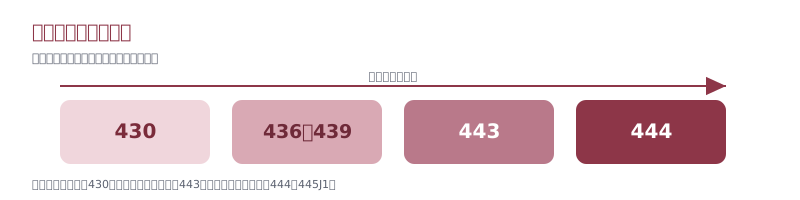
430, 436, 439, 443, 444 are all ferritic; corrosion resistance low→high: 430<436≈439<443<444. See one gradient table.
Common comparisons & substitutions
| Common question | Conclusion source |
|---|---|
| Can 304 replace 316L in pharma applications? | Product-contact surfaces in pharma use 316L (molybdenum-bearing, Ra≤0.8μm, traceable); 304 is for non-contact structural parts only. |
| Which suits a water tank better, 444 or 316L? | For ambient chlorinated tap-water storage tanks, 444 resists pitting close to 316L and is nickel-free; use 316L for aggressive duty or complex welded structures. |
| How much difference is there between 2205 and 316L in seawater? | For seawater/coastal service, prefer 2205 duplex; for milder duty needing good weldability use 316L — the key is chloride level and SCC. |
| Between 2507 and 904L, is the more expensive one always better? | 2507 resists chloride SCC and allows downgauging; 904L resists reducing acids. Grade by medium — not simply the pricier one. |
| What's the difference between 420 and 304? Which for making blades? | 420 heat-treats to HRC50–55, hard and wear-resistant — essential for blades; 304 is corrosion-resistant but not wear-resistant. |
| Is 304 the safest choice for a water tank? | For long-term chlorinated tap-water plant tanks, prefer high-Cr-Mo ferritic grades like 445J1 over 304. |
Grade quick reference
Covers 2205, 2507, 316L, 316, 304, 310S, 904L, 445J1, 444, 443, 439, 436, 430, 420, 254SMO, etc. <a href="/questions.html#牌号对比替换">16 Q&A on grade comparison</a> cover the same.
This article is written by @Stainless Insights. @Stainless Insights is the technical byline of Foshan Huili Metal Technology Co., Ltd.(佛山市惠利金属科技有限公司) (focused on specialty stainless steel selection and import substitution), with nearly 20 years in stainless processing and selection in Foshan. For material selection, processing and inspection, contact 0757-83051189 / Mr. He 13703060845.